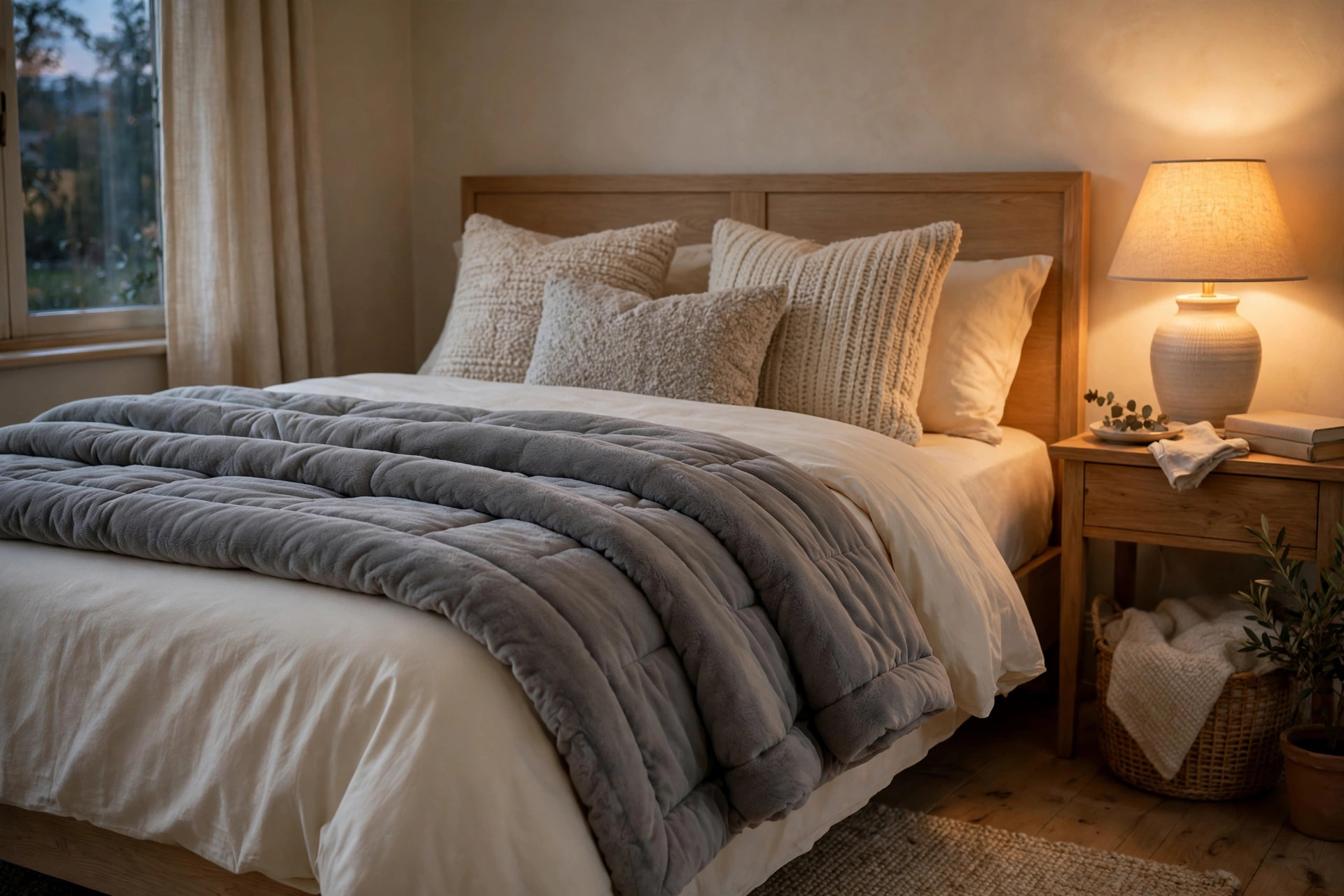
There's a specific kind of sleeplessness that has nothing to do with noise or light: the body is tired, the room is perfect, and the mind simply will not stand down. Weighted blankets target exactly that. The even, distributed pressure — called deep pressure stimulation — mimics the sensation of being held or swaddled, and a meaningful share of users report falling asleep faster and waking less during the night. But the category is full of traps: wrong weight, cheap fill that shifts into corners, and fabrics that turn a warm sleeper into a furnace. This guide covers how to size one, what the fillings actually do, and the best weighted blankets for genuinely better sleep.
How weighted blankets work (and what they can't do)
The idea is simple: a blanket filled with dense micro-beads distributes 10–25 pounds evenly across your body, and that steady pressure activates the parasympathetic nervous system — the "rest and digest" branch — which most people experience as calming. It's the same principle behind swaddling infants, compression garments, and why some people sleep better with a heavy duvet or a partner's arm across them.
The evidence is promising but not miraculous. Studies generally find weighted blankets help with the experience of falling asleep — reduced self-reported anxiety, a greater sense of calm — more than with objective sleep architecture. Translation: if your problem is a racing mind at bedtime, a weighted blanket is well worth trying. If your problem is sleep apnea, chronic pain, or a snoring partner, it won't move the needle — see our weighted blankets buying guide for the full background and our other sleep-environment guides for those issues.
Safety notes, stated plainly: weighted blankets are not recommended for children under about 50 pounds without pediatric guidance, and anyone with respiratory issues, sleep apnea, or claustrophobia should check with a clinician first. The blanket should never cover the face, and you should be able to move freely underneath it.
Sizing: the 10% rule and the mistakes everyone makes
The standard guidance is a blanket around 10% of your body weight, plus or minus a couple of pounds. A 150-pound sleeper lands on a 15-pound blanket; a 200-pound sleeper on a 20-pound blanket. This is a starting point, not a law — personal preference varies widely, and many people prefer slightly lighter than the formula suggests for their first blanket.
The three sizing mistakes: going too heavy (a 25-pound blanket on a 130-pound sleeper feels like being pinned, not hugged — when in doubt, size down); buying bed-sized instead of body-sized (a weighted blanket should cover you, roughly twin-size for one adult, not drape over the whole king bed — oversized blankets slide off and pool weight unevenly); and ignoring heat (a 20-pound blanket is inherently insulating, so hot sleepers need a cooling-specific model, not just a lighter one).
For couples: two individual blankets beat one shared blanket almost every time. A single shared weighted blanket migrates toward whoever moves less, leaving one partner buried and the other uncovered. Individual sizing also lets each person pick their own weight.
What to look for in a weighted blanket
Glass micro-beads over plastic pellets. Glass beads are denser, quieter, and distribute weight more evenly than the larger plastic poly-pellets found in cheap blankets. They also feel smoother and less "lumpy." This is the single biggest quality divider in the category.
Small quilted compartments. The fill should be sewn into small squares (4–5 inches) that keep the beads from migrating. Large compartments or — worse — unquilted fill means all the weight ends up at your feet by morning. Check product photos for tight, even quilting.
Breathable, removable cover. A removable, washable cover is close to mandatory — you cannot easily wash a 20-pound blanket, and the cover is what touches your skin. Hot sleepers should look for bamboo, Tencel, or specifically marketed cooling covers.
Even weight distribution, honestly described. Reputable listings state the fill material, the compartment size, and the exact weight options. Vague listings ("premium weighted fill!") are hiding plastic pellets and big compartments.
The picks: best weighted blankets for better sleep
We compared specs across the blankets sleepers actually buy — fill material, compartment construction, cover options, and weight range. Prices move; check current listings.
Best overall: 15 lb glass-bead blanket
A 15-pound glass-bead weighted blanket is the right default for most adults: glass micro-beads in small quilted compartments, a removable washable cover, and the 10%-rule weight for the 130–170 pound sleeper. Look for seven-layer construction (the layering is what keeps beads from shifting and adds the soft hand-feel) and duvet-cover ties so the cover stays put. Usually $50–$90, which is the category's value sweet spot.
- Pros: glass beads distribute weight evenly and quietly — no crunchy plastic-pellet feel
- Pros: removable cover makes washing realistic; 15 lb suits the broad middle of adult body weights
- Cons: still warm by nature — hot sleepers need the cooling pick below, not this one
- Cons: 15 lb is wrong for smaller adults — size to your body, not to the "best overall" label
Best for hot sleepers: cooling weighted blanket
A cooling weighted blanket pairs the glass-bead fill with a breathable bamboo or moisture-wicking cover and, on the better models, a lighter overall construction that traps less heat. This is the pick that makes weighted blankets viable for people who run warm — and it's the difference between using the blanket nightly and abandoning it by June. Expect $70–$120; the cooling cover is worth the premium if heat is your issue.
- Pros: breathable cover and lighter build meaningfully reduce heat buildup vs. standard models
- Pros: same calming deep pressure without the furnace effect
- Cons: costs more than standard blankets at the same weight
- Cons: "cooling" is relative — it's cooler than a standard weighted blanket, not actively cold
Best for couples: two individual blankets (or a split king)
For couples, the winning move is two individually-sized weighted blankets rather than one giant shared one — each partner gets their own weight and the blankets stay where they belong. If you insist on one blanket for the bed, look for king-size models explicitly designed for sharing, and size the weight to the lighter partner to avoid pinning anyone. Budget roughly double the single-blanket cost; sleep harmony is worth it.
- Pros: each partner gets the right weight — no compromise sizing
- Pros: eliminates the midnight blanket-migration war entirely
- Cons: two blankets cost twice as much and look less tidy on the bed
- Cons: some couples miss the shared-blanket coziness — a real, if minor, tradeoff
Best budget: affordable glass-bead blanket
A budget glass-bead weighted blanket in the $35–$55 range proves you don't need to spend $150 to test whether deep pressure works for you. At this price, insist on glass beads (not plastic pellets) and check reviews specifically for bead leakage and compartment stitching — those are where cheap blankets fail. Treat it as a trial: if you love the effect, upgrade to a premium cover later.
- Pros: the cheapest honest way to find out if weighted sleep works for you
- Pros: glass-bead options exist even at this price if you shop carefully
- Cons: covers tend to be basic polyester — warmer and less pleasant than bamboo
- Cons: stitching and bead retention are the common failure points; read the 1-star reviews
Best for kids and teens: properly-sized kids' blanket
A kids' weighted blanket follows the same 10% rule at a smaller scale — typically 5–7 pounds — with fun covers that make it feel like a choice rather than a treatment. The safety guidance matters more here: the child should be able to move the blanket independently, it should never cover the face, and it's worth a conversation with the pediatrician first, especially for younger kids. Usually $30–$60.
- Pros: kid-appropriate weights with covers kids actually want on their bed
- Pros: can genuinely help with bedtime restlessness and the transition to independent sleep
- Cons: sizing is critical and kids grow — a blanket that's right this year may be wrong next year
- Cons: not a substitute for addressing real sleep or anxiety issues with a professional
Getting used to it: the two-week adjustment
Don't judge a weighted blanket on night one. The first few nights often feel odd — some people find the weight reassuring immediately, others find it restrictive until the brain recategorizes it as normal. Start by using it for the first hour of the night or during reading-in-bed time, then extend to full nights over a week or two. Most regular users report the adjustment takes 5–10 nights.
Washing reality check: the blanket itself is almost never machine-washable at 15+ pounds (and your washer will thank you for not trying). The removable cover goes in the wash regularly; the inner blanket gets spot-cleaned and aired out. If a listing claims the whole 20-pound blanket is machine washable, read the fine print — it usually means "technically fits in a commercial washer."
And layer it sensibly: the weighted blanket replaces your comforter or duvet, not your sheets. Sleeping under both a weighted blanket and a heavy duvet is how people end up overheated and convert to blanket skeptics. Sheets, weighted blanket, done — adjust the room temperature, not the stack.
Our verdict
For most adults, a 15-pound glass-bead blanket with a removable cover is the right first buy — it's the 10%-rule weight for the broad middle of body sizes and the category's value sweet spot. Hot sleepers should go straight to the cooling model rather than suffering through summer with a standard one, and couples should buy two individual blankets instead of fighting over a shared one. Give any of them a full two weeks before deciding — deep pressure is a learned comfort, and the payoff is the particular quiet of a mind that finally stood down.
Frequently asked questions
How heavy should my weighted blanket be?
Around 10% of your body weight is the standard starting point — 15 pounds for a 150-pound adult. When between sizes or buying your first, sizing down slightly is the safer choice; too heavy feels restrictive rather than calming.
Will a weighted blanket make me overheat?
Standard models do sleep warm — 15+ pounds of fill is inherently insulating. Hot sleepers should choose a cooling-specific blanket with a breathable bamboo or moisture-wicking cover, use it as the only top layer, and keep the room cool.
Can kids use weighted blankets?
Generally yes for older children, sized to about 10% of the child's body weight (typically 5–7 pounds), with the child able to move it independently. Not recommended for toddlers or infants, and worth discussing with a pediatrician first.
How do you wash a weighted blanket?
Wash the removable cover regularly in a normal machine; spot-clean the inner weighted blanket and air it out. Most weighted blankets over about 12 pounds should not go in a home washing machine.
Do weighted blankets help with anxiety or just sleep?
Many users report the calming effect extends to restless evenings generally — reading, winding down, anxiety flare-ups — not just sleep onset. The research base is strongest for self-reported calm and sleep satisfaction rather than clinical anxiety treatment, which deserves professional care.