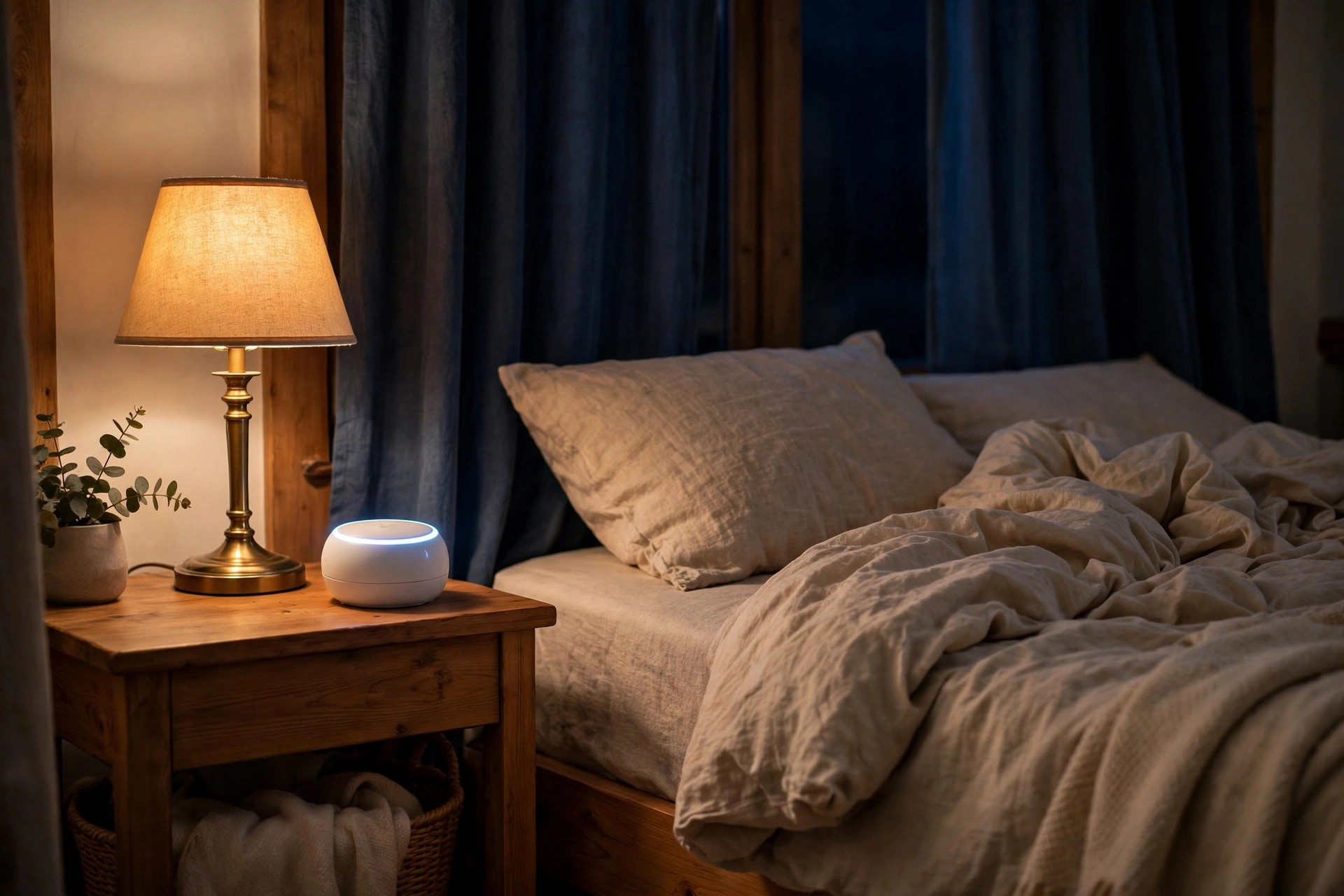
You can have the perfect mattress, blackout curtains, and a cool room — and still get shredded awake at 3 a.m. by a car alarm, a snoring partner, or the upstairs neighbor's 5 a.m. routine. A white noise machine doesn't make your bedroom quieter; it makes it consistently noisy, which is what your sleeping brain actually wants. Sudden changes in sound wake you up, not sound itself. A steady wash of noise raises the floor so the spikes — the door slam, the dog bark — stop registering. This guide covers how white noise works, the specs that separate good machines from annoying ones, and the best picks for genuinely deeper sleep.
Why consistent sound beats silence
Your auditory system never fully shuts down during sleep — it keeps monitoring for threats, which in evolutionary terms means sudden changes. A completely silent bedroom is actually fragile: every tiny noise becomes an event. That's why people who "need total quiet" still wake up when the refrigerator cycles on. White noise works by masking: a constant broadband sound that blends intermittent noises into the background so your brain stops flagging them.
The research is genuinely supportive here, not just marketing. Studies on white noise and sleep consistently find it shortens the time to fall asleep and reduces nighttime awakenings, especially in noisy environments — hospital wards, city apartments, houses near roads. It won't fix sleep apnea, restless legs, or a 2 a.m. anxiety spiral, but for the enormous category of "my environment keeps waking me up," it's the cheapest effective intervention in the sleep world. See our broader overview in white noise machines that work for the fundamentals.
One honest limit: volume discipline matters. Sleep specialists generally recommend keeping the machine at or below about 50 decibels — roughly the level of a quiet conversation — and placing it across the room rather than right next to your pillow, especially for long-term nightly use and always for babies' rooms.
What to look for in a white noise machine
Non-looping sound. This is the spec that matters most and the one cheap machines fail. Many budget units play a 10-second sound clip on repeat — and your brain will learn the loop point, at which point the "seam" becomes its own little 3 a.m. alarm. Machines with true non-looping generation (or a real fan moving real air) don't have this problem. If a listing doesn't say "non-looping," assume it loops.
Sound variety that you'll actually use. White noise (equal energy across frequencies, a "shhh" hiss), pink noise (deeper, more "whoosh," often preferred for sleep), and brown noise (deep rumble) are the core three. Fan sounds, rain, and ocean are nice bonuses. Ignore machines boasting 50 sounds — you'll use two.
Volume range and fine control. You want enough maximum volume to mask a snoring partner through a closed door, but fine low-end control for quiet nights. A machine that jumps from "barely audible" to "jet engine" in three steps is badly designed.
Sleep timer and continuous play. A timer is nice for falling asleep, but for staying asleep through the night, continuous all-night play is what you want — a machine that shuts off at 2 a.m. can wake you with the silence. Confirm it can run all night.
No bright lights, no app required. A sleep device with a glowing display defeats your blackout setup. And while app control is a nice extra, the machine should work fully from physical buttons — at 3 a.m., you don't want to be hunting for your phone.
The picks: best white noise machines for deeper sleep
We compared specs across the machines sleepers actually buy — sound generation method, looping behavior, volume control, and nighttime usability. Prices move; check current listings.
Best overall: full-featured digital sound machine
A full-featured white noise sound machine is the best default: true white, pink, and brown noise plus fan and nature sounds, non-looping generation, a wide volume range, and an all-night continuous mode. Look for one with a completely darkable display and physical buttons. Expect $30–$60 for a machine that gets all of this right — this is the category's sweet spot, and it's where most sleepers should land.
- Pros: non-looping sound across white, pink, and brown noise — no 3 a.m. seam to learn
- Pros: wide volume range masks snoring partners and street noise without blasting
- Cons: digital sound, however good, still isn't quite as natural as a real fan to some ears
- Cons: feature-packed models can have fiddly button layouts in the dark
Best natural sound: mechanical fan-based machine
A fan-based white noise machine uses a real spinning fan inside an acoustic chamber — actual moving air, not a recording. The result is the most natural rushing-air sound in the category, and it's non-looping by physics rather than by engineering. If you've ever slept best with a box fan running, this is that, tuned for the nightstand and without the cold draft. Usually $50–$70, with adjustable tone via vent settings rather than digital EQ.
- Pros: genuinely non-looping — real airflow can't have a loop seam
- Pros: the most natural, least "electronic" sound; beloved by long-time fan sleepers
- Cons: one sound only (rushing air) — no rain, no pink noise, no variety
- Cons: larger and slightly more expensive than digital equivalents
Best budget: compact bedside machine
A compact white noise machine in the $20–$30 range covers the essentials: white noise plus a few alternatives, a sleep timer, and USB power. At this price, verify the non-looping claim carefully in reviews — this is where loop seams hide. For a guest room, a kid's room, or a first machine to test whether white noise works for you, budget is a perfectly rational starting point.
- Pros: under $30 gets you masking sound that genuinely works
- Pros: small footprint and USB power suit nightstands, travel, and kids' rooms
- Cons: looping artifacts are most common at this price — check reviews for the seam complaint
- Cons: smaller speakers mean thinner sound at high volume
Best for travel: portable pocket machine
A portable travel white noise machine is the hotel-room essential: pocket-sized, battery-powered, and loud enough to mask hallway noise and thin walls. The best ones clip to a bag, run 8+ hours on a charge, and remember your last settings. If you sleep great at home and terribly on the road, this single purchase often fixes the entire category of travel sleep.
- Pros: turns any hotel room, guest room, or in-law suite into your acoustic home base
- Pros: battery power means no hunting for outlets behind hotel nightstands
- Cons: tiny speakers can't match a full-size machine's depth at home
- Cons: easy to leave in a hotel room — buy the one with a bright color
Best for light sleepers: adaptive-volume machine
An adaptive-volume white noise machine listens to the room and raises its own output when ambient noise spikes — a passing truck, a barking dog — then settles back down. For very light sleepers, this is meaningfully better than a fixed volume: you don't have to choose between "too quiet to mask the truck" and "too loud all night." Expect $60–$100; the premium buys the microphone-driven smarts.
- Pros: responds to real noise events instead of blasting at one fixed level all night
- Pros: ideal for unpredictable environments — city streets, thin apartment walls
- Cons: the most expensive type, and the adaptive feature can feel gimmicky if your noise is steady
- Cons: microphone-based features occasionally misread room noise — check recent reviews
Setting it up for deeper sleep: placement and volume
Placement matters more than most people expect. Put the machine between you and the noise source — near the window if it's street noise, near the bedroom door if it's a snoring partner in the next room or hallway sounds — rather than right next to your pillow. Across-the-room placement lets the sound fill the space evenly and keeps the volume at your ears lower, which is better for long-term nightly use.
Start the volume just loud enough to soften the noises that wake you, then nudge it down over a few nights — most people end up lower than their first-night setting. Give it a full week before judging: the first two or three nights can feel strange if you're used to silence, and then the brain files the sound under "safe background" and stops noticing it entirely. That's the goal — a machine you forget is on until the power goes out and you suddenly remember why you bought it.
Pair it with the rest of the setup: white noise handles sound, but it can't fix light (see blackout curtains and sleep masks) or temperature. The complete sleep environment is dark, cool, and consistently noisy — in that order of impact for most people.
Our verdict
For most sleepers, a full-featured digital machine with true non-looping sound in the $30–$60 range is the right buy — it's the category's sweet spot on sound quality, volume range, and nighttime usability. Devoted fan-sleepers should go mechanical; frequent travelers need the portable one regardless of what sits on the nightstand at home. Whatever you choose, verify the non-looping claim in recent reviews before buying — it's the single spec that separates machines people love from machines that end up in a drawer.
Frequently asked questions
Is it safe to use white noise every night?
For adults, nightly use at moderate volume (around 50 decibels or below, machine across the room rather than at the pillow) is considered safe by sleep specialists. For babies, pediatric guidance is stricter: keep it as far from the crib as practical, keep volume low, and consider turning it off once the baby is asleep.
What's the difference between white, pink, and brown noise?
White noise has equal energy across all audible frequencies (a bright "shhh"). Pink noise emphasizes lower frequencies (a deeper "whoosh," like steady rain). Brown noise goes deeper still (a low rumble, like a distant waterfall). Many sleepers prefer pink or brown for sleep; try all three for a few nights each.
Can a white noise machine help with snoring?
It can mask a snoring partner surprisingly well — consistent broadband noise is exactly what snoring's intermittent bursts fail against. It won't help the snorer, and very loud habitual snoring may still break through; in that case the snorer should be evaluated for sleep apnea, which is a medical issue, not a noise issue.
Should it run all night or on a timer?
All night, for most people. A timer that shuts the machine off at 2 a.m. replaces masking sound with sudden silence — itself a change your sleeping brain can notice. Continuous play keeps the acoustic environment stable through the light-sleep phases where awakenings happen.
Phone app vs. dedicated machine?
A phone app works in a pinch and is fine for travel, but a dedicated machine wins for nightly use: no notifications interrupting the sound, no battery anxiety, physical buttons in the dark, and no glowing screen. The machine is a $40 upgrade to a system you'll use for years.