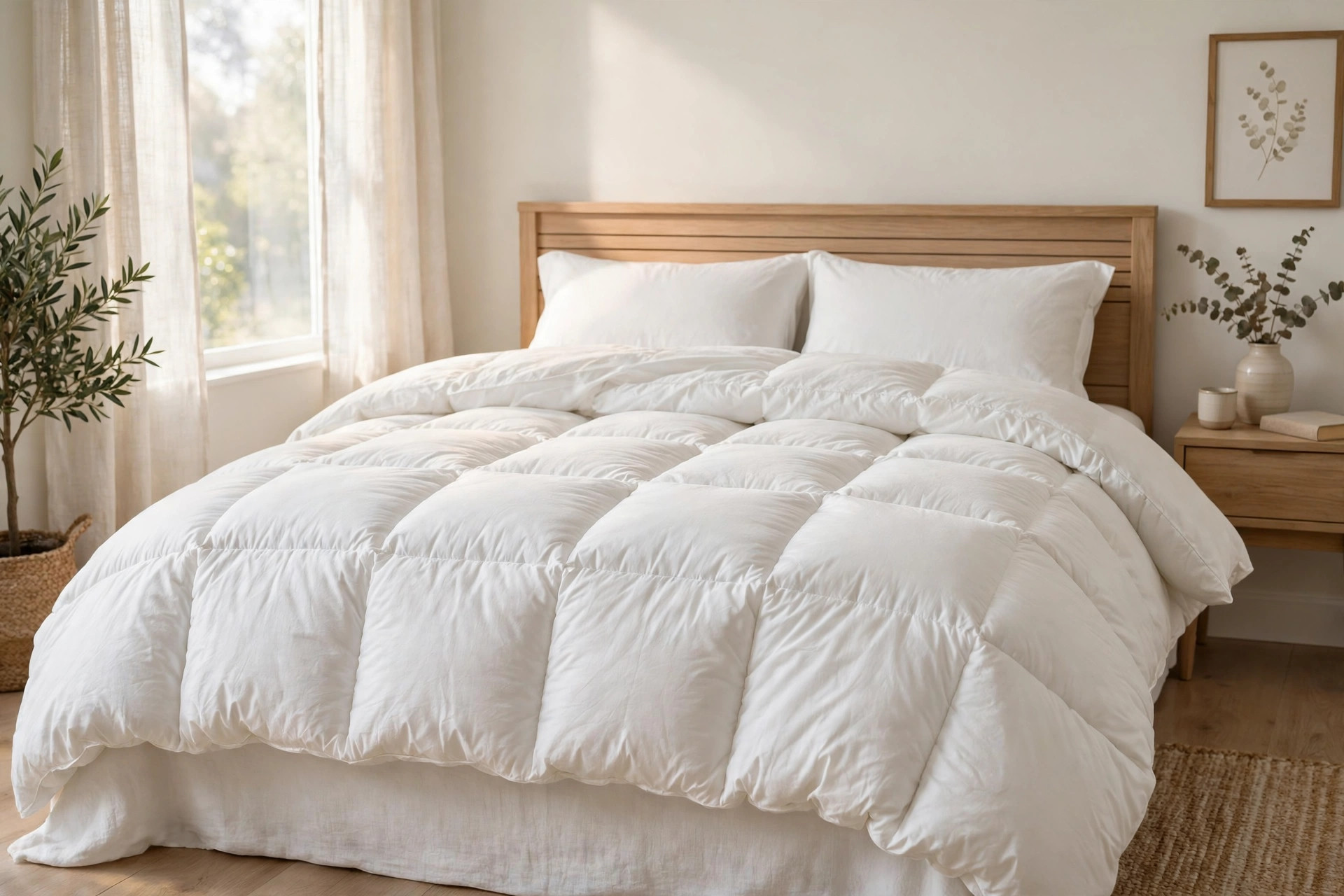
There is a specific kind of winter sleep that only a good down comforter delivers: warm everywhere, heavy nowhere, the bed feeling like it was pre-heated without a single degree of stuffiness. The difference between that and a bad down comforter is not luck — it’s fill power, construction, and warmth level, three specs that listings either explain honestly or bury under adjectives like “cloud-like” and “luxury.” This guide covers what those specs actually mean, when down beats down-alternative, and the best down comforters for genuinely better winter sleep.
Nap Dialed is reader-supported. When you buy through links on our site, we may earn an affiliate commission. Read the full disclosure.
Our picks
- Brooklinen Down Comforter Best overall
- Parachute Down Comforter Best luxury
- The Company Store Legends Hotel Down Comforter Best hotel-style
- Casper Humidity-Fighting Duvet Insert Best for hot sleepers
- Amazon Basics Down Comforter Best budget
Quick comparison
| Product | Best for | Key spec | Check price |
|---|---|---|---|
| Brooklinen Down Comforter | Most sleepers | 700 fill power; baffle-box; three warmth levels; typically ~$300–$400 | Check price → |
| Parachute Down Comforter | Luxury feel | 750 fill power; European down; baffle-box; typically ~$300–$450 | Check price → |
| The Company Store Legends Hotel Down Comforter | Hotel-bed feel | 600 fill power; oversized; baffle-box; typically ~$250–$400 | Check price → |
| Casper Humidity-Fighting Duvet Insert | Hot sleepers | 650 fill power; moisture-wicking; lightweight warmth; typically ~$200–$300 | Check price → |
| Amazon Basics Down Comforter | First down comforter | 550 fill power; sewn-through; all-season weight; typically ~$60–$100 | Check price → |
Fill power, warmth, and the numbers that matter
Fill power is the one spec that actually predicts how a comforter feels: it measures how much space one ounce of down fills, in cubic inches. Higher fill power means bigger, fluffier down clusters that trap more air per ounce — so a 700-fill-power comforter is warmer at the same weight than a 550, and lighter at the same warmth. The practical bands: 500–600 is solid mid-range, 600–700 is genuinely good, 700+ is premium. Below 500, you’re paying for weight rather than loft.
Fill power alone doesn’t set warmth, though — fill weight does. A lightweight 700-fill comforter can be cooler than a heavy 550-fill one. That’s why good comforters come in warmth levels (lightweight, all-season, ultra-warm): the level tells you how much down is inside, and the fill power tells you how good that down is. When choosing, pick the warmth level for your climate and bedroom temperature first, then the fill power for quality. Cold sleepers in cool rooms want all-season or ultra-warm; warm sleepers and heated bedrooms want lightweight or all-season.
Two more numbers worth checking: the down-to-feather ratio (listed as something like 90/10 — higher down content means softer, lighter, and less quill poke-through) and the shell’s thread count (a tight-weave cotton shell, 300+ thread count, is what keeps down from leaking out through the fabric over time).
Down vs. down alternative
Down alternative — usually microfiber polyester clusters — exists for three good reasons: allergies, price, and washability. It’s genuinely the right choice for anyone with a down allergy, for tight budgets, and for anyone who wants to machine-wash the whole comforter regularly. Modern down-alternative fills are far better than the flat polyester batting of a decade ago.
But down still wins on the two things that define the category: warmth per ounce and lifespan. A good down comforter is lighter at the same warmth, drapes better (it follows your body instead of tenting over it), and lasts 10–15 years with basic care, where down-alternative typically goes flat in 3–5. If you’re not allergic and you’re buying for the long term, down is the better value despite the higher price — the per-year cost is usually lower.
Baffle-box vs. sewn-through construction
This is the construction detail that decides whether your comforter stays evenly warm or develops cold spots. In baffle-box construction, fabric walls separate the top and bottom layers into three-dimensional boxes, so the down stays evenly distributed and the comforter keeps its full loft. In sewn-through construction, the top and bottom are stitched directly together, pinching the fill to nothing along every seam — those seams become cold lines across the bed.
The rule is simple: baffle-box for any comforter you’ll use as your main winter layer; sewn-through is acceptable for a lightweight summer comforter or a budget first buy. Check product photos for the boxy, puffy grid of a baffle-box build — if the comforter looks flat with stitched diamonds, it’s sewn-through, and the price should reflect it.
Shell fabric and sizing
The shell is the comforter’s skin, and it does two jobs: keep the down in and feel good against you (or against your duvet cover). Cotton is the standard — breathable, quiet, and durable — and a tight weave matters more than thread-count bragging. Avoid crinkly-feeling shells; that’s usually a sign of a cheap synthetic that will also leak down faster.
On sizing, the honest rule is to buy one size up from your bed: a queen comforter on a queen bed leaves the sides short, especially once a duvet cover is on. A king comforter on a queen bed drapes properly and covers two sleepers without a midnight tug-of-war. Oversized comforters are also the hotel trick — that generous drape is half of what makes a hotel bed feel like a hotel bed.
And use a duvet cover. It protects the comforter from body oils and spills (down comforters should be washed rarely — spot clean and air them out, with a professional clean every few years), it’s the part you actually wash, and it lets you change the look of the bed without replacing the expensive part.
The picks: best down comforters for winter sleep
We compared specs across the comforters sleepers actually buy — fill power, construction, warmth options, and shell quality. Prices move; check current listings.
Brooklinen Down Comforter Best overall
The Brooklinen Down Comforter is the right default for most sleepers: 700 fill power, baffle-box construction, and three warmth levels so you buy the weight for your climate instead of guessing. The Canadian down is RDS-certified, the cotton shell is tightly woven enough to keep leakage minimal, and the all-season weight suits the broad middle of sleepers — warm in winter without being stifling in spring. Usually ~$300–$400, which is the category’s value sweet spot for real quality.
- 700 fill power with baffle-box construction — warm, lofty, and evenly filled
- three warmth levels let you match the comforter to your climate
- premium price — budget buyers should look at the Amazon Basics pick
- needs a duvet cover for everyday use; the shell alone shows stains
Best for: most sleepers buying their first serious down comforter
Not ideal for: tight budgets — the budget pick below is the honest alternative
Our verdict: The right first buy for most sleepers — real fill power, real construction, and the warmth level you actually need.
Parachute Down Comforter Best luxury
The Parachute Down Comforter is the splurge pick: 750 fill power European down in a baffle-box build, with a loft and drape that feel a clear step above the mid-range. It’s the comforter for people who notice bedding — the weight distribution, the way it settles around you, the fact that it still looks full after years of use. Expect ~$300–$450 depending on size and warmth level; the premium over the Brooklinen buys higher fill power and a more refined shell, not a different category of sleep.
- 750 fill power European down — the loftiest, lightest warmth on this list
- baffle-box construction keeps the fill even for years
- the most expensive pick here for a modest gain over the best overall
- ultralight warmth level can feel too light for very cold rooms
Best for: sleepers who want the best-feeling comforter and will notice the difference
Not ideal for: anyone on a budget — the best overall is 90% of this for less
Our verdict: The luxury pick that earns it — the loft and drape are genuinely a step up.
The Company Store Legends Hotel Down Comforter Best hotel-style
The Company Store Legends Hotel Down Comforter is the pick for the hotel-bed feeling at home: 600 fill power in an oversized, baffle-box cut that drapes generously over the sides of the bed. The oversizing is the point — it’s what makes the bed look and feel like the ones in good hotels, with no short sides and no tug-of-war between two sleepers. Usually ~$250–$400; watch for the brand’s frequent sales, which often cut the price substantially.
- oversized cut drapes like a hotel bed — no short sides, no cold gaps
- baffle-box construction with a solid 600 fill power
- 600 fill power is good, not premium — heavier than the top picks at the same warmth
- list price is high; the real price is usually a sale price
Best for: couples and anyone chasing the hotel-bed drape
Not ideal for: small bedrooms — the oversized cut needs a bed it can hang off
Our verdict: The hotel-bed pick — buy the oversized cut and wait for a sale.
Casper Humidity-Fighting Duvet Insert Best for hot sleepers
The Casper Humidity-Fighting Duvet Insert solves the problem that keeps hot sleepers away from down: it pairs 650 fill power down with a moisture-wicking design that moves humidity away from the body instead of trapping it. The result is a comforter that insulates without the clammy buildup that makes warm sleepers kick the covers off at 3 a.m. It’s a lightweight-to-all-season warmth, so it’s not the pick for a freezing bedroom — but for hot sleepers it’s the difference between using a down comforter and not. Usually ~$200–$300.
- moisture-wicking design makes down viable for hot sleepers
- 650 fill power with baffle-box construction at a mid-range price
- lightweight warmth won’t suit very cold rooms
- “humidity-fighting” is relative — it manages moisture, it doesn’t cool actively
Best for: warm sleepers who want down without waking up sweaty
Not ideal for: cold rooms — choose an all-season or ultra-warm pick instead
Our verdict: The pick that makes down work for hot sleepers — moisture management, not magic.
Amazon Basics Down Comforter Best budget
The Amazon Basics Down Comforter is the cheapest honest way to find out whether you like sleeping under down: real down (550 fill power) at roughly a quarter of the premium price, in an all-season weight that suits most bedrooms. The compromises are visible — sewn-through construction instead of baffle-box, so cold lines can form along the seams, and a basic shell that leaks a little down at first. But as a trial or a guest-room comforter, it’s genuinely good value. Usually ~$60–$100.
- real down at a fraction of premium prices — the cheapest honest trial
- all-season weight suits most bedrooms and most sleepers
- sewn-through construction can develop cold spots along the seams
- basic shell may shed some down early on; expect a break-in period
Best for: trying down for the first time, or a guest room
Not ideal for: a long-term daily driver in a cold climate
Our verdict: The cheapest honest trial — real down, real warmth, with the construction corners you’d expect at the price.
Getting the most from a down comforter
Fluff it daily — a quick shake each morning restores loft that compresses overnight, and it takes ten seconds. Air it out regularly: hang it over a chair or a line for a few hours every month or two, which keeps it fresh without washing. Wash it rarely: a duvet cover takes the daily wear, and the comforter itself only needs a professional clean every few years, or a gentle machine wash in a large-capacity washer when it genuinely needs it. Dry it thoroughly — damp down clumps, smells, and loses loft, so tumble-dry low with dryer balls until it’s completely dry.
Layer it sensibly with the rest of the bed: the comforter is the warm layer, so pair it with breathable sheets — our cooling sheets guide covers the fabrics that keep the bed from overheating underneath. If you run cold even under a good comforter, the problem is often the room or the mattress, not the top layer: our mattress topper guide and weighted blanket guide cover the other half of the warmth equation.
Our verdict
For most sleepers, the Brooklinen Down Comforter in all-season weight is the right first buy — 700 fill power, baffle-box construction, and the warmth level you actually need at the category’s value sweet spot. Hot sleepers should go straight to the Casper Humidity-Fighting insert rather than fighting a standard comforter all winter, and anyone chasing the hotel look should buy The Company Store Legends oversized on sale. Give any of them a full two weeks before deciding — down needs a break-in period to reach full loft, and the payoff is the particular quiet of a bed that’s warm everywhere and heavy nowhere.
Frequently asked questions
What fill power should I buy?
600–700 fill power is the sweet spot for most sleepers — genuinely lofty without the premium price of 750+. Below 550 you’re paying for weight rather than warmth; above 700 you’re paying for refinement most sleepers won’t notice.
Is a down comforter too warm for hot sleepers?
Not necessarily — down breathes better than synthetic fills, and lightweight warmth levels exist for exactly this reason. Hot sleepers should choose a lightweight or all-season down comforter with moisture-wicking properties (like the Casper pick above) and pair it with breathable sheets.
How do I wash a down comforter?
Rarely. Use a duvet cover as the washable layer, spot-clean small marks, and air the comforter out regularly. When it genuinely needs washing, use a large-capacity front-loader on gentle with down-specific detergent, then tumble-dry low with dryer balls until completely dry — damp down clumps and loses loft.
Down or down alternative — which is better?
Down wins on warmth per ounce, drape, and lifespan (10–15 years vs 3–5). Down alternative wins on price, washability, and allergies. If you’re not allergic and you’re buying for the long term, down is the better value.
Why is my new down comforter flat?
New comforters arrive compressed for shipping and need 24–48 hours to reach full loft — shake it out, let it breathe, and give it a few nights. If it’s still flat after a week, the fill power or fill weight is lower than advertised.